

March saw John on site to prepare for work starting at Easter.
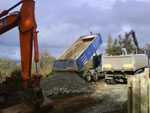

Under Ali’s guidance, one of the first jobs was to prepare the access. Several tons of (fortunately for our green credentials) very local stone was imported to create good access and a turning space for delivery vehicles and workers, not to mention ourselves. It seemed like a lot of expense but was well worth it.

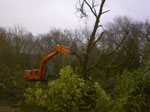
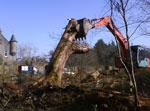
They also cleared more of the dead trees and shrubs, including the invasive rhododendrons. The site was transformed when the cedar which lay across the house site was lifted out of the way.
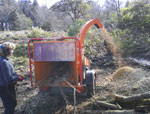

We hired a huge shredder and fed it for a week. This was really hard work as the tangled rhododendrons didn’t go in straight. But the piles of chippings were used between the house and the caravan on top of terram matting to provide a clean surface for walking on, working and doing tai chi. What was left will be used for paths elsewhere. Ali’s daughter Holly had other ideas.
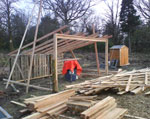
 The caravan was moved up behind the house site, off the driveway and John built a verandah and hut for the compost toilet. The ‘office’ for the site and for Suse to continue working was to be located in the back half of the caravan, with the living accommodation in the other half, meaning we would have to sleep in the campervan to save putting up the bed every night and taking it down every morning. The barn, built from odd bits of wood from the sawmill, provided shelter for tools and work space.
 The solar powered electricity that had performed so well last summer (for lights and the water pump) was not getting enough sun now so we bought a petrol generator to get us through to better days.
We were waiting for the landowner to give us permission to run the phone and electricity cables to the site but he had gone to Australia. Andrew and Rosie very kindly let us take water from their hose pipe to fill the tank. I didn’t quite manage to balance it on my head and I didn’t have miles to walk, but I certainly gained an appreciation of what it must be like to live in parts of the world where water isn’t on tap.
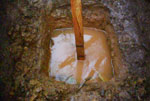 Speaking of water, we were still struggling to find the best solution for our waste water. The Earthship system had never been tested in domestic life and we could not find anyone else who was using it in this country – even Earthship Brighton. The ecoplay system doesn’t go far enough to be worth the money. It only takes water from one bath or shower to feed one toilet. We had two shower rooms and a bathroom and there was still no solution for the grey water from the kitchen and laundry. We carried out percolation tests to see if anything could be achieved using a soakaway contouring in the topsoil but even this involved importing a lot of material.
We looked at the Irish Puraflow system which runs the outfall from a septic tank through peat and we looked at a Biodisc which is more than a septic tank but needs electricity. Neither seem very sustainable. In either case, because we are not discharging directly into running water, we have to provide a soakaway or reed bed of some kind.
In Argyll there is not exactly a shortage of water and in Scotland we do not have metered water (yet) so there is little incentive to save or to be frugal with water. I read a report about a small trial carried out in identical houses in a new town in England where a water recycling system was fitted. The households included a single man, two couples, a couple with a baby and a single girl. At the end of the trial, the single man had used least water (he didn’t cook) and the single girl the most. Surprisingly the couple with the baby had been the second least extravagant. That just seemed to show to me that it doesn’t matter a great deal what systems you have in place as it all depends on your lifestyle and habits.
In our last house we had a very long pipe run from the heated water in the kitchen to our shower room. By the time the hot water had reached the shower, you could have washed your hair and had a shower, so we used twice as much water as was necessary every day – each. Architect Chris is very clued up about this and has designed a very neat water supply with the furthest away bathroom using water heated by an instant water heater to avoid waste. He also specifies spray taps which use a lot less water and of course dual flush toilets. The rest will be up to us.
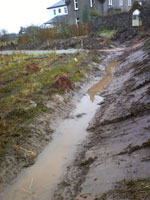 We are collecting rainwater in two ponds, which also accept land drains and we can use this to water the garden.
We also plan to keep the compost toilet in the garden after the house is built to save having to go indoors and get changed when you are caught short in the garden. You have to see human pooh and urine as a resource, not as a waste product.
Mum, I can tell you wrote this one. Tells all the little interesting details and explanations.
Also the caravan set up isn’t as bad as it looks. The compost toilet isn’t too bad. It doesn’t smell and even has a wooden toilet seat. I still wouldn’t be able to do it for as long as you both have. You are welcome to Broxburn anytime x
I thought that On Site at Last was very interesting. I found you searching on Baby Bath Supply Tuesday Thanks for the nice post!